


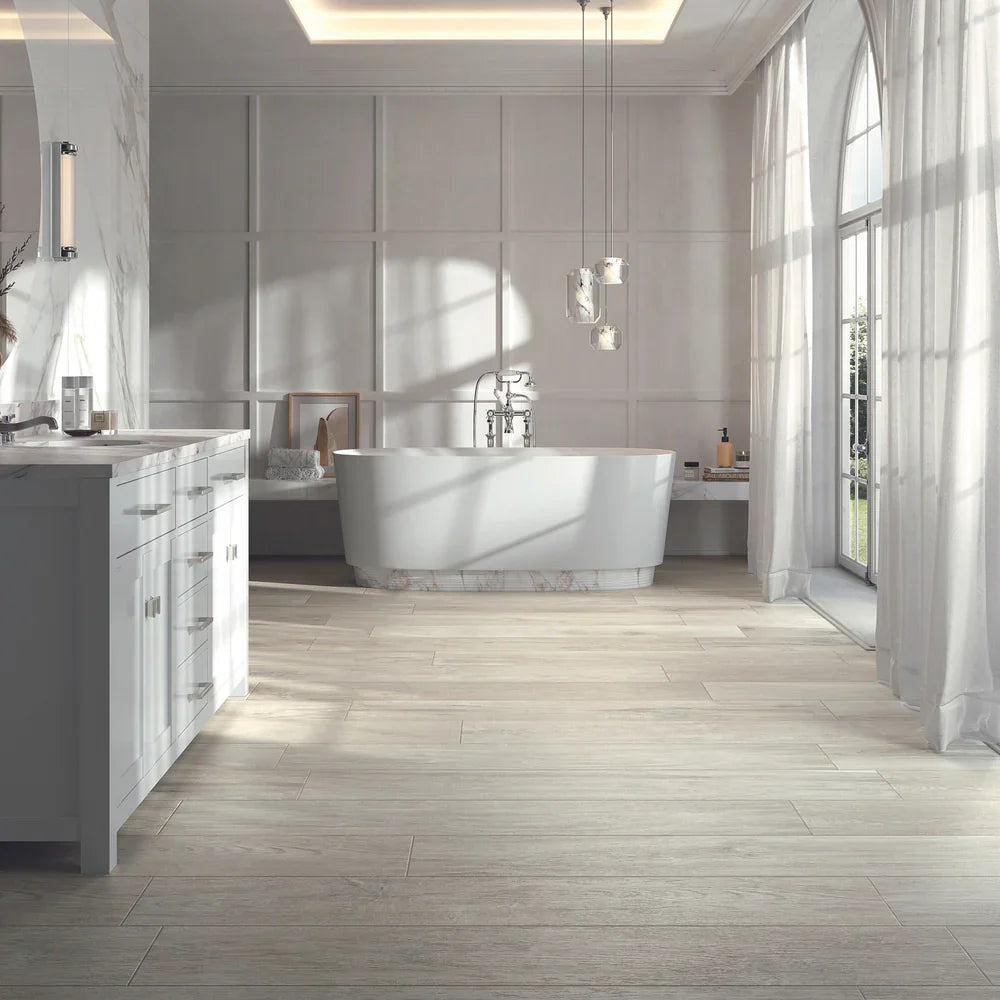
For small bathrooms, the large format tile sizes that work best are 600×600mm, 600×1200mm and 300×600mm. These sizes reduce the number of grout lines across the floor and walls, which makes the surface read as one continuous plane and the room feel larger. The fewer the visual breaks, the more open a compact space looks. Large format porcelain in these sizes is available at Austpek Bathrooms, with delivery across Australia.
This guide covers which sizes suit a small bathroom, how to lay them, and the practical details (grout, rectified edges, tile variation) that decide whether the result looks seamless or busy.
Why Large Format Tiles Suit Small Bathrooms
It seems counterintuitive that a big tile suits a small room, but it works because of grout lines. A floor tiled in small mosaics can have dozens of grout joints across a single square metre, and each line is a visual break that chops the space into pieces and draws the eye to the room's edges. A large tile covers the same area with only a few joints, so the surface reads as continuous and the boundaries feel further away.
The effect carries to the walls too. Large tiles with minimal pattern give a smooth, uninterrupted surface that makes a compact bathroom feel more open, while a quieter, more even tone keeps the eye moving across the space rather than stopping at every join.
Best Large Format Tile Sizes for Small Bathrooms
600×600mm - The Reliable All-Rounder


For most small bathrooms, especially those under about 5 square metres, 600×600mm is the easiest size to work with. It is large enough to cut grout lines dramatically compared with mosaics or 300×300mm, but small enough to handle on both floors and walls without awkward cuts in a tight room. A square format also creates a clean, grid-like rhythm that suits a simple, contemporary look.
This is the deepest part of the range, with 600×600mm square tiles available in matte and natural finishes and a wide spread of neutral tones. Examples include the Muses Mistery matte in light and dark grey and the Everstone Meteorite natural matte.
-
Best for: floors and walls in compact bathrooms, simple stack or grid layouts
-
Price: from around $90 per box
600×1200mm - The Most Spacious Look


If you want the most open, high-end result, 600×1200mm is the format to choose. The large rectangle covers walls and floors with very few joints, and laid the right way it can stretch the proportions of the room. Marble-look and stone-look porcelain in this size brings an elegant, expansive feel that belies a small footprint.
In the range this size appears in marble-look and soft-polished stone-look finishes, such as the Muses Silver Root soft polished and the Muses Mistery matte in grey tones.
-
Best for: a luxurious, expansive feel; feature walls and open floors
-
Price: from around $110 per box
300×600mm - The Easy-to-Lay Rectangle


For very small or awkwardly shaped bathrooms, 300×600mm is a practical middle ground. It is still clearly a large format compared with traditional small tiles, but the smaller rectangle is more forgiving around fixtures, niches and tight corners, and it works well laid vertically to add a sense of height. It is also a popular choice for walls paired with a larger floor tile.
The range includes 300×600mm in matte and textured finishes across both brands, including the Muses Find matte greys and the Muses Mistery matte.
-
Best for: small or irregular layouts, vertical wall layouts, wall-and-floor pairings
-
Price: from around $90 per box
Going Larger: 1200×600mm, 1200×1200mm and Slabs
For a near-seamless look, the range also extends to 1200×600mm, 1200×1200mm and large slab formats up to 3200×1600mm. These create the fewest joints of all, but they need a very flat substrate and are heavier to handle, so they suit a renovation with professional installation rather than a quick refresh. In a genuinely small bathroom they can be excellent on a feature wall, where one or two tiles cover the whole surface.
-
Best for: feature walls, seamless floors, professionally installed renovations
-
Price: from around $200 per box (1200×600mm); large slabs priced individually
How to Lay Large Format Tiles in a Small Bathroom
The size is only half the result; the layout decides the rest.
A simple stack or straight grid keeps grout lines minimal and the look calm, which is what makes the space feel larger. Busy patterns work against a small room, so it is usually best to keep the layout quiet and let the tile size do the work.
Direction matters. Laid horizontally, a large rectangular tile draws the eye along the wall and makes a narrow bathroom feel wider. Laid vertically up the wall, the same tile adds a sense of height, which helps in a room with a low ceiling. Choose the direction that corrects your room's proportions.
Continuing the same tile from floor to wall, or running the floor tile into the shower without a change of material, removes another visual break and reinforces the sense of one continuous space.
The Details That Make Tiles Look Seamless
-
Rectified edges. A rectified tile has precisely cut, straight edges, which allows a very thin grout joint. This is what makes large format tiles look almost jointless. Most of the porcelain in this range is rectified, so it is well suited to a minimal-grout look.
-
Grout colour. Match the grout closely to the tile colour. A contrasting grout outlines every tile and emphasises the joints, which is the opposite of what a small room wants. A close tonal match makes the joints disappear.
-
Tile variation (the V rating). Porcelain tiles carry a shade-variation rating from V1 (very uniform) to V4 (substantial variation from tile to tile). For a calm, expansive look in a small bathroom, a lower-variation tile gives the smoothest, most even surface. A higher-variation stone- or marble-look tile is more dynamic and characterful, which can be beautiful but is busier, so it is best used with intent, often on a single feature wall.
-
Substrate. The larger the tile, the flatter the wall or floor needs to be, since a large rigid tile will not follow an uneven surface. For 1200mm tiles and slabs especially, proper substrate preparation is essential, which is another reason the largest formats suit a full renovation.
Choosing the Right Size for Your Bathroom
As a simple guide: for a standard small bathroom, 600×600mm is the safe, versatile choice. For the most open and premium feel, step up to 600×1200mm. For a very small or awkward layout, 300×600mm is the most forgiving. And for a feature wall or a seamless renovation, the larger formats and slabs deliver the fewest joints of all.
All of these sizes are available in porcelain at Austpek Bathrooms, one of Australia's largest premium bathroom ranges, with marble-look, stone-look and matte finishes and delivery across Australia. If you are renovating a full bathroom, the team can help you match tiles to your vanity, screen and fixtures, and put together a package.
A practical tip before you order: tiles are sold per box, and a box covers a different floor area depending on the tile size. Work out your room's area in square metres first, add around 10% for cuts and wastage, then check how many boxes that are needed for your chosen size. Ordering sample tiles first lets you see the colour, finish and variation in your own light before committing.
Frequently Asked Questions
What size tiles make a small bathroom look bigger?
Large format tiles in 600×600mm, 600×1200mm or 300×600mm make a small bathroom look bigger by reducing the number of grout lines, so the surface reads as one continuous plane. Fewer visual breaks make the room feel more open.
Are large tiles a good idea in a small bathroom?
Yes. Large tiles reduce grout lines and create a seamless, expansive look that makes compact bathrooms feel larger, provided the layout is kept simple and the substrate is flat enough to support the tile size.
Should large bathroom tiles be laid horizontally or vertically?
Lay them horizontally to make a narrow bathroom feel wider, or vertically to add height in a room with a low ceiling. Choose the direction that corrects your room's proportions.
What is the best grout colour for large format tiles in a small bathroom?
A grout colour closely matched to the tile makes the joints recede and the surface look seamless. Contrasting grout outlines every tile and emphasises the joins, which makes a small room feel busier.
Do large format tiles need special installation?
Larger tiles need a flat, well-prepared substrate because a rigid tile will not follow an uneven surface. Sizes up to 600×1200mm are manageable in most renovations, while 1200mm tiles and slabs are heavier and best installed by a professional.
How many tiles do I need for a small bathroom?
Calculate your floor or wall area in square metres, add around 10% for cuts and wastage, then divide by the coverage of your chosen tile size. Because tiles are sold per box and box coverage varies by size, check the coverage per box before ordering.


